The Bomb That Wasn't Destroyed: Iran's Nuclear Program After Operation Epic Fury

On the evening of May 29, 2026, President Donald Trump sat in the White House Situation Room to make what aides described as a "final determination" about a framework for extending the ceasefire with Iran. The meeting ended without a clear decision being announced. Hours earlier, Trump had posted his terms on Truth Social: Iran must permanently forgo nuclear weapons, reopen the Strait of Hormuz without tolls, clear naval mines, and cooperate with the United States and the International Atomic Energy Agency in eliminating its stockpiles of highly enriched uranium.
That last demand — the elimination of Iran's highly enriched uranium stockpiles — points to the most consequential unresolved question of the entire conflict: where is the uranium, and what is Iran doing with it?
Three months into a ceasefire that has been tested, extended, threatened, and partially violated, the nuclear dimension of the Iran crisis remains as dangerous as ever — arguably more so, because the strikes that were supposed to solve it have, in important ways, made the problem harder to see.
A Program Decades in the Making
Iran's nuclear program has been the central source of tension between Tehran and the Western world for more than two decades. Since the early 2000s, when a dissident group revealed the existence of secret enrichment facilities at Natanz and Fordow, the international community has attempted through diplomacy, sanctions, sabotage, and ultimately military force to prevent Iran from acquiring nuclear weapons capability.
The technical core of the problem is uranium enrichment. Natural uranium contains less than one percent of the fissile isotope uranium-235 (U-235). Nuclear reactor fuel is enriched to 3–5 percent U-235. Research reactors use material enriched to 20 percent. Weapons-grade uranium requires enrichment to 90 percent or above. Iran pursued enrichment at Natanz and Fordow using cascades of gas centrifuges — machines that spin uranium hexafluoride gas at high speeds to concentrate U-235.
By May 2025, the IAEA reported that Iran had accumulated 408.6 kilograms of uranium enriched to 60 percent U-235 — a level with no plausible civilian application that exists, in the view of proliferation experts, primarily as a stepping stone to weapons-grade material. Only a short additional cycle of enrichment is necessary to bring 60 percent material to the 90 percent weapons threshold. At that enrichment level, approximately 42 kilograms is sufficient for a single nuclear device. Iran's 440-kilogram stockpile at 60 percent represented, by IAEA reckoning, enough feedstock for approximately ten weapons if further enriched. The IAEA chief, Rafael Grossi, had warned that Iran's stockpile was "unprecedented for a state without nuclear weapons."
That accumulation was the proximate trigger for Operation Midnight Hammer — the June 2025 U.S. airstrikes on Iran's nuclear facilities at Natanz, Fordow, and Isfahan — and ultimately for the broader Operation Epic Fury that began February 28, 2026.
What the Strikes Actually Did — and Didn't Do
The administration's public characterization of the strikes was sweeping. President Trump repeatedly stated that U.S. operations had "obliterated" Iran's nuclear program. The reality, as it has emerged from IAEA assessments, intelligence leaks, and open-source analysis, is considerably more complicated.
Operation Midnight Hammer in June 2025 caused genuine damage. IAEA reporting confirmed that the aboveground pilot fuel enrichment plant at Natanz was destroyed, and that other facilities suffered significant damage. The Institute for Science and International Security, reviewing post-strike IAEA reports, concluded that Iran "no longer has an identifiable route to produce weapon-grade uranium in its centrifuge plant" — a significant degradation of Iran's declared enrichment capability.
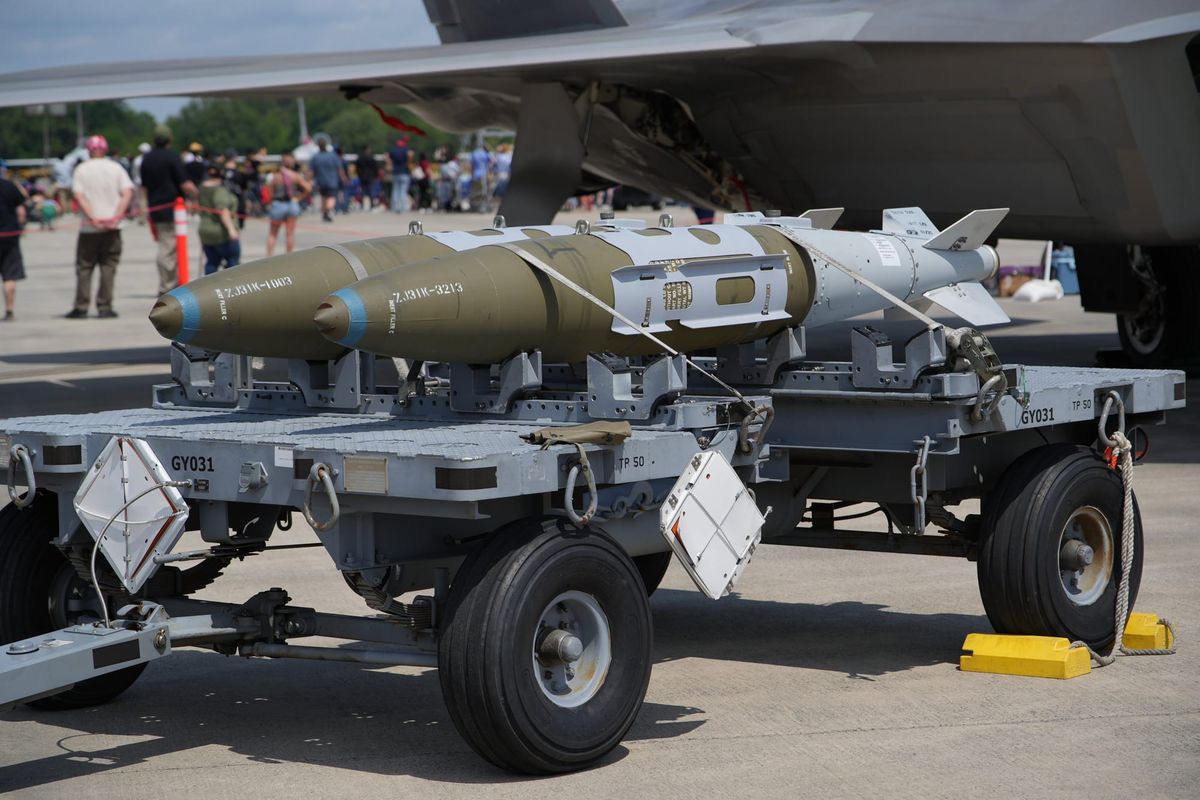
But Fordow — the facility that represents the most serious proliferation risk — proved harder to destroy than analysts had hoped. Built deep inside a mountain near Qom, Fordow was constructed precisely to survive air attack. Even the GBU-57 Massive Ordnance Penetrators used against it — the largest conventional bombs in the U.S. arsenal, each weighing 30,000 pounds and designed specifically to destroy hardened underground facilities — caused tunnel collapses at the facility but left its core centrifuge halls, analysts now assess, only approximately 30 percent damaged. The central enrichment infrastructure buried deepest inside the mountain may remain substantially intact.
The February-March 2026 strikes of Operation Epic Fury targeted a broader range of nuclear-related facilities: senior leadership nodes, missile production sites, administrative hubs, dual-use scientific research facilities, and what reports suggest was the headquarters of Iran's Atomic Energy Organization in Tehran. Israel, operating in parallel under Operation Roaring Lion, struck up to eleven weaponization facilities, the headquarters of Iran's nuclear weaponization program known as SPND, and eliminated at least eight nuclear scientists — adding to the twelve scientists killed in the June 2025 campaign.
The cumulative damage is real and significant. Natanz's main enrichment plant is assessed at roughly 75 percent destroyed, with over 6,000 centrifuges destroyed. The Isfahan conversion complex is approximately 90 percent destroyed. The Arak reactor sustained roughly 60 percent damage. Across the program, an estimated 2,600 kilograms of enriched uranium at various enrichment levels was destroyed in the strikes.
But not all of it.
The Missing Uranium: The Most Dangerous Unknown
Four days before Israel launched Operation Midnight Hammer in June 2025, IAEA Director General Grossi observed something that would become the defining intelligence puzzle of the entire crisis: satellite imagery showed 18 blue containers — believed to be carrying roughly 200 kilograms of uranium enriched to 60 percent — being moved into a tunnel at the Isfahan nuclear complex. The convoy moved the material underground before the strikes arrived.
Iran's Revolutionary Guard commander Mohsen Rezaei was explicit after the June strikes: the enriched material had been moved to "secure locations," and Iran would "not give up its position."
By the time Operation Epic Fury began in February 2026, Iran had accumulated 440.9 kilograms of 60 percent enriched uranium — enough for approximately ten weapons if further enriched. The U.S. and Israeli strikes targeted the facilities where that material had been stored. Some of it was almost certainly destroyed. The rest is unaccounted for.
U.S. intelligence assessed that the June 2025 strikes on Iran's enrichment facilities had buried much of Iran's highly enriched uranium stockpile at Isfahan — but had not destroyed it. President Trump's own administration stated the nuclear program had been "obliterated," while the IAEA and independent analysts pushed back. IAEA Director General Grossi said as recently as April 2026 that Iran's enriched uranium stockpile "remains in the country" and that based on satellite imagery, more than 200 kilograms of 60 percent enriched uranium is likely still located at Isfahan — under rubble, in tunnels, in containers whose contents cannot be verified by any international inspector.
The reason no inspector has verified anything is that Iran terminated all IAEA access on February 28, 2026 — the first day of Operation Epic Fury. Surveillance cameras at every declared Iranian nuclear facility were disabled. Seals were removed. Inspectors were eventually evacuated for safety as the military campaign intensified. As of June 2026, the IAEA is operating in a total verification blackout — unable to confirm the extent of strike damage, the current location of enriched material stockpiles, or whether covert enrichment activities are underway somewhere in Iran's dispersed and partially underground nuclear enterprise. IAEA Director General Grossi has stated plainly that any peace agreement which does not include provisions for the resumption of inspections will be "an illusion of an agreement."
Fordow: The Proliferation Risk That Survived
The Fordow Fuel Enrichment Plant is, in the considered judgment of most proliferation analysts, the greatest remaining nuclear risk in Iran.
Built between 2006 and 2009 inside a mountain near the holy city of Qom, Fordow was designed from the outset to survive air attack. Its centrifuge halls are buried under roughly 80 meters of rock. The facility's existence was only revealed to the outside world in 2009, when U.S. President Obama confronted Tehran with evidence of its construction at the G20 summit in Pittsburgh. Under the JCPOA, Fordow was converted to other uses with a reduced centrifuge complement. After Iran began violating the deal's terms in 2019, enrichment at Fordow resumed and eventually reached the 60 percent level. Environmental samples taken by IAEA inspectors at Fordow in January 2023 had already detected uranium particles enriched to 83.7 percent U-235 — one step below weapons-grade — raising alarms that were never fully resolved.
The GBU-57 Massive Ordnance Penetrators used against Fordow in both the June 2025 and February 2026 strikes caused significant structural damage to the tunnel approaches and access corridors. But the core enrichment facility, buried deepest within the mountain, appears from available evidence to have survived substantially intact. Current estimates suggest Fordow's deep bunker sustained approximately 30 percent damage — meaning 70 percent of what was there when the bombs fell may still be functional.
If Iran retains any operational centrifuges at Fordow, and if it retains the 60 percent enriched uranium that was moved to secure locations before the strikes, the combination represents a nuclear breakout capability that has not been eliminated. With Fordow's surviving IR-6 centrifuges — more advanced and productive than the older IR-1 models destroyed at Natanz — the enrichment of 60 percent material to weapons-grade 90 percent could potentially be accomplished in a matter of weeks. The full pathway from weapons-grade material to a deliverable nuclear device would take considerably longer: metallurgy, core fabrication, and warhead integration are technically demanding steps that cannot be rushed without risking a dud rather than a weapon. Most estimates place that timeline at six to eighteen months from a political decision to proceed, even with existing enriched material.
The dispersal and concealment of Iran's program — built over decades specifically to survive exactly this kind of military campaign — means that even the most aggressive air strikes cannot provide the certainty that the problem has been solved.
The Covert Site: A New Dimension of Concern
In March 2026, President Trump publicly referenced something that had not previously been acknowledged: Iran had been conducting nuclear activities at a new, deeper site, protected by granite. "They were starting work at another site, a different site… that was protected by granite… they wanted to go a lot deeper and they started the process," Trump told reporters, adding that this had continued "even after we obliterated their key nuclear sites" in the June 2025 strikes.
The revelation, whether intended as a justification for continued military pressure or as a genuine intelligence disclosure, underlines the fundamental limitation of airpower as a counterproliferation tool. A nuclear program that has been developing for decades, with thousands of scientists, dispersed facilities, and the institutional knowledge embedded in a surviving cadre of nuclear engineers, cannot be fully eliminated by bombs. It can be set back. It can be disrupted. It can be made more expensive, more difficult, and more dangerous to pursue. But a country with Iran's resources, its surviving scientific talent, and its now deeply-motivated political leadership — a leadership that has watched its declared facilities be destroyed and has drawn the obvious conclusion about what deterrence requires — is not a country that has been permanently disarmed.
Israel eliminated at least twenty nuclear scientists across the two campaigns. It struck multiple weaponization facilities and research hubs. These losses are genuinely significant setbacks. But Iran was producing nuclear scientists faster than Israel was eliminating them, and the institutional knowledge concentrated in a program that has been running for more than twenty years cannot be entirely extirpated by targeted strikes.
The Diplomatic Endgame: What a Deal Would Need to Accomplish
The ceasefire that has been in effect since April 8 — tested repeatedly, extended, and currently under negotiation for a more durable extension — is the framework within which the nuclear question must ultimately be resolved, if it is to be resolved through diplomacy at all.
The U.S. position, as stated by Trump personally, is maximal: no enrichment, no nuclear weapons, full cooperation with the IAEA, and the elimination — not merely the dilution or storage — of Iran's existing highly enriched uranium stockpile. Trump stated explicitly that Iran would not receive sanctions relief in exchange for giving up its highly enriched uranium. The implicit logic is that if Iran gets economic benefits merely for surrendering material it shouldn't have accumulated in the first place, the deal creates perverse incentives for the next country contemplating a similar path.
Iran's position has evolved under the enormous pressure of military defeat and economic devastation. Iranian representatives proposed diluting the 400-kilogram stockpile of 60 percent enriched uranium in-country and restoring IAEA access to bombed sites in exchange for full sanctions relief — while stopping short of agreeing to transfer enriched uranium abroad, a demand the U.S. regards as the minimum acceptable verification measure. The gap between "dilute in-country" and "transfer abroad" is not merely technical. It is existential from Tehran's perspective: uranium in Iran, even diluted, is uranium that could theoretically be re-enriched. Uranium transferred to Russia or another third country is gone.
U.S. and Iranian negotiators reached what officials described as a tentative agreement in late May 2026 to extend the ceasefire by 60 days while substantive nuclear negotiations continue. But within hours of that announcement, Trump published demands that were not in the tentative agreement, Iranian officials accused the U.S. of acting in bad faith, and the prospect of an extended ceasefire remained uncertain. Negotiators are set to continue talks, but the fundamental gaps have not been bridged.
Defense Secretary Pete Hegseth, speaking from Singapore on May 29, was unambiguous about what happens if diplomacy fails: the U.S. military is ready to resume combat in the Gulf, he told reporters, and is "more strongly placed to do so than on day one of the conflict." The force is "rearmed and retooled." General Dan Caine, chairman of the Joint Chiefs of Staff, had made the same point at the ceasefire announcement in April: "A ceasefire is a pause and the joint force remains ready, if ordered or called upon, to resume combat operations — with the same speed and precision as we've demonstrated over the last 38 days."
The Intelligence Deficit: Operating Blind
Underlying every aspect of the nuclear debate is a fundamental intelligence problem that no amount of military capability can solve: the United States and its partners do not know exactly where Iran's surviving enriched uranium is, what state Iran's surviving centrifuge capacity is in, or whether covert enrichment is occurring somewhere outside the known declared facilities.
Iran terminated IAEA access on February 28, 2026. Cameras are offline. Seals are broken. No inspector has set foot inside an Iranian nuclear facility since the military campaign began. The most significant IAEA verification blackout in the history of the Iran monitoring relationship is ongoing, and it is not a temporary administrative disruption — it is a deliberate Iranian policy choice, reflecting Tehran's assessment that inviting international inspectors into facilities that have just been bombed would allow the United States and Israel to assess the actual damage and plan follow-on strikes more precisely.
The intelligence community can look at satellite imagery and count the craters. It can intercept communications. It can run signals intelligence and human sources. But it cannot with confidence tell the President of the United States how many working centrifuges remain at Fordow, or whether the 440 kilograms of 60 percent enriched uranium that was unaccounted for before the strikes has been destroyed, dispersed, or is sitting in a tunnel awaiting a political decision to enrich it further.
IAEA Director General Grossi's condition for any meaningful diplomatic outcome is therefore not bureaucratic formalism — it is the irreducible minimum of verification that would make any agreement worth the paper it is signed on. "Unless and until Iran assists the IAEA in resolving the outstanding safeguards issues," he said, "the Agency will not be in a position to provide assurance that Iran's nuclear program is exclusively peaceful."
Without that assurance, any ceasefire that does not address the nuclear question is, as Grossi put it, "an illusion of an agreement."
What Comes Next
Three possible futures are in view from the vantage point of June 1, 2026.
In the first, diplomacy produces a durable agreement: Iran agrees to transfer its remaining highly enriched uranium stockpile abroad, submits to intrusive IAEA inspections including access to sites not previously declared, accepts permanent limits on enrichment capacity, and in exchange receives phased sanctions relief and security guarantees. This is the outcome U.S. officials describe as their objective. It is also the outcome Iran's leadership has given no clear indication of accepting on American terms.
In the second, the ceasefire holds in a degraded form — extended repeatedly, with the nuclear question unresolved, as both sides pursue their objectives through economic pressure, covert action, and the implicit threat of resumed combat. Iran retains its surviving enriched uranium, rebuilds its enrichment capacity slowly and covertly, and the region lives with a permanently ambiguous Iranian nuclear threat that neither military force nor diplomacy has fully resolved.
In the third, diplomacy collapses, the ceasefire ends, and Operation Epic Fury resumes. The military questions that would then arise — can Fordow's surviving centrifuge halls be destroyed with weapons the United States currently possesses, and can a stockpile of enriched uranium whose location is not fully known be eliminated by air attack? — do not have reassuring answers.
What is not in view, from any vantage point, is a future in which the question has been definitively closed. The bombs fell. Many of Iran's nuclear facilities lie in rubble. Iran's nuclear scientists are fewer in number and its centrifuge inventory is substantially reduced. But the knowledge is not gone. The material is not fully accounted for. The deep bunker at Fordow may still hold functional machines. And the U.S. defense secretary is in Singapore reminding the world that the military remains ready.
The bomb that wasn't built has not been made impossible to build. That is the challenge that all the military power in the world has not yet solved.
Key Facts at a Glance
- Iran's 60% enriched uranium stockpile (pre-strike): 440.9 kg — sufficient feedstock for ~10 nuclear weapons if further enriched to 90%
- Weapons-grade threshold: 90% U-235 enrichment; ~42 kg needed per device
- IAEA access terminated by Iran: February 28, 2026 (all surveillance cameras disabled, all seals removed)
- Natanz main plant damage: ~75% (6,000+ centrifuges destroyed)
- Fordow deep bunker damage: ~30% — core centrifuge halls may be intact
- Isfahan conversion complex damage: ~90%
- Estimated enriched uranium destroyed in strikes: ~2,600 kg across all enrichment levels
- Status of 440.9 kg at 60%: Location uncertain; IAEA believes most is likely still at Isfahan, possibly underground
- Intelligence assessment (majority U.S./Israeli): Program set back 2–3 years minimum; some assessments more optimistic
- Post-strike breakout time to weapons-grade HEU: Estimated 2–12 weeks under medium-confidence scenarios, depending on Fordow centrifuge status
- Deliverable warhead timeline from political decision: 6–18 months, if enriched material is available
- Ceasefire effective date: April 8, 2026 (extended indefinitely April 21; tentative 60-day extension framework under negotiation)
- IAEA condition for any agreement: Full resumption of inspections and resolution of outstanding safeguards issues
- Current U.S. military posture: "Ready to resume combat operations with the same speed and precision" (General Caine, April 8, 2026)
ArmedForcesNews.com covers U.S. and global military developments. All figures cited are sourced from official U.S. government releases, IAEA statements, congressional research, and open-source defense and nonproliferation reporting.