Going North: The Marine Corps Establishes Its First Permanent Arctic Rotational Force

For most of its history, the United States Marine Corps has been defined by amphibious operations in warm-water theaters — the beaches of the Pacific, the shores of the Korean Peninsula, the deserts of the Middle East. The Corps has always prided itself on being ready to fight anywhere, but the Arctic has rarely been the setting it prepared for most deliberately. That is changing.
On May 9, 2026, the Marine Corps formally announced "Campaign – Alaska," a strategic initiative establishing two interlocking capabilities: the Marine Rotational Force – Alaska (MRF – Alaska) and a permanent Supporting Arms Liaison Team – Alaska (SALT – Alaska). Together, they represent the first time the Marine Corps has institutionalized a persistent, dedicated Arctic presence in Alaska — not a one-time exercise, not a passing deployment, but a structural commitment to operating in one of the most demanding and strategically consequential environments on earth.
The announcement reflects a recognition that has been building for years across the U.S. military: the Arctic is no longer a peripheral theater. It is becoming a central one.
What Campaign – Alaska Actually Creates
The initiative has two distinct but complementary components, designed to address both the immediate operational need for Arctic-capable forces and the longer-term requirement for institutional continuity and joint integration.
The first element, the Marine Rotational Force – Alaska, is a task-organized Marine Air-Ground Task Force (MAGTF) built to operate in what Senator Dan Sullivan (R-Alaska), chairman of the Senate Armed Services Subcommittee on Readiness, described as "extreme cold weather, austere terrain, and limited-infrastructure conditions." The MRF – Alaska will vary in size depending on the time of year and the exercises planned, and the Marine Corps has not yet specified which units will form the inaugural rotation or exactly where in Alaska they will be based. What is clear is the functional role: the rotational force will serve as an advance and integration element — a dedicated team that arrives in Alaska to plan, coordinate, and embed with the joint force before and during Arctic training exercises, providing the structural continuity that episodic exercise participation has lacked.
Marine Capt. Steven Keenan described the value plainly: "Somebody who's dedicated to planning and getting integrated with the joint force is the real value that that provides. That extra structure behind the exercise planning and exercise involvement we were already doing."
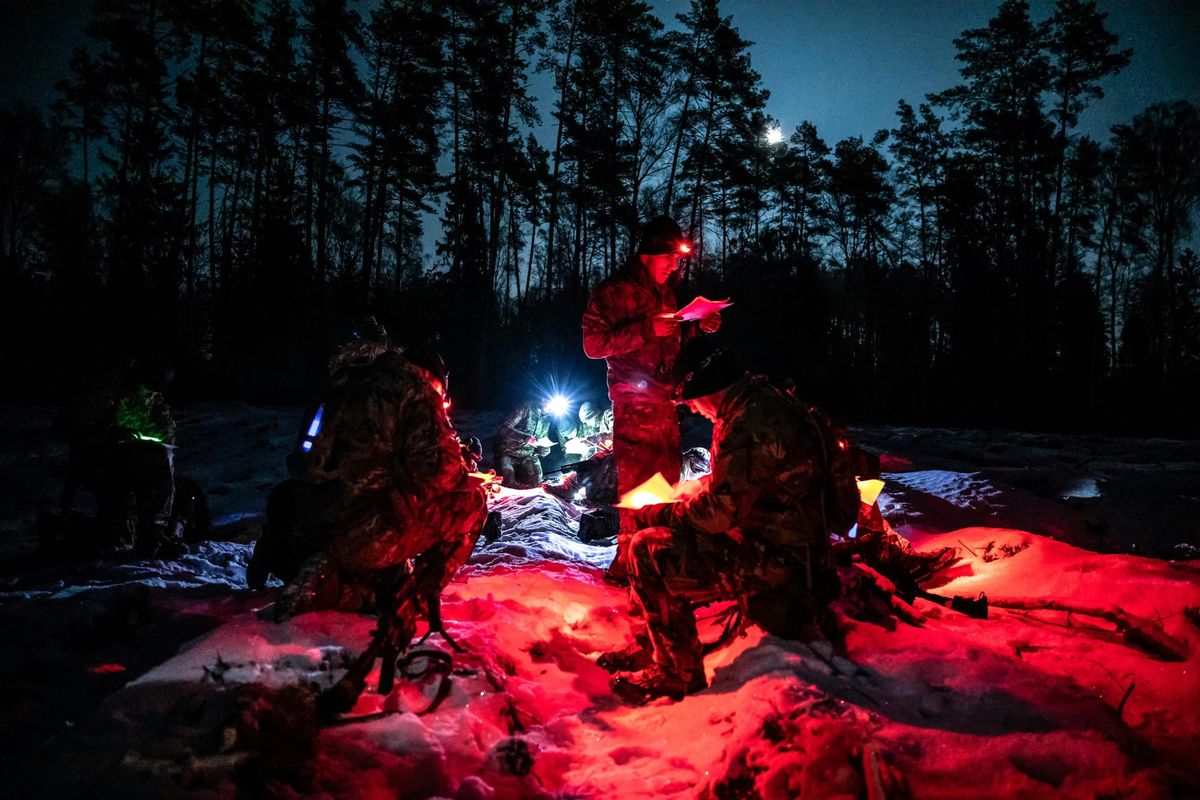
The rotational force has already been active. It participated in Arctic Edge 2026, the major NORAD and U.S. Northern Command-led homeland defense exercise held in Alaska in February and March, where it exercised counter-drone operations and air defense of expeditionary bases, undersea infrastructure protection, distributed sustainment and logistics, and aviation command and control. It has also participated in the Red Flag exercise and is planning additional future rotations.
The second element, SALT – Alaska, is more permanent in character. Marine Corps Forces Reserve is establishing a detachment of the 6th Air Naval Gunfire Liaison Company (ANGLICO) at Joint Base Elmendorf-Richardson (JBER) in Anchorage — the largest joint installation in Alaska and the hub of U.S. military activity in the state. By fiscal year 2027, this detachment will provide a year-round, persistent Marine Corps presence that ensures continuity in Arctic operations between rotational deployments and positions the force for rapid expansion when needed.
ANGLICO units are some of the most specialized in the Marine Corps. The 6th ANGLICO can coordinate close air support, call in supporting artillery and rocket fire, direct naval gunfire from ships, and integrate allied and coalition firepower operating in the same area. Its specialists include Joint Terminal Attack Controllers — JTACs — the highly qualified personnel who direct combat aircraft onto targets from the ground. A permanent ANGLICO presence in Alaska means that whatever joint or allied force assembles in the High North will always have Marine Corps fire integration expertise available to them, regardless of where the rotational force is in its cycle.
MARFORRES's presence in Alaska actually dates to 1985, giving SALT – Alaska a foundation to build on rather than starting from scratch. But the formalization of that presence as a named, mission-focused component of a named campaign represents a qualitative shift — from a legacy presence to a deliberate strategic posture.
Why Now: The Arctic as a Theater of Competition
To understand why the Marine Corps is making this commitment in 2026, it is necessary to understand what has happened to the Arctic over the past decade — and what analysts now believe is coming.
The Arctic was, for most of the 20th century, treated primarily as a buffer zone in the nuclear standoff between the United States and the Soviet Union. Ballistic missile submarines slipped under the ice cap. Bombers flew polar routes. Radar installations watched the approaches from the north. But direct military competition for control of Arctic territory, resources, or sea lanes was largely theoretical — the region was simply too remote, too inaccessible, and too costly to exploit for either side to treat as a genuine operational theater.
Climate change has fundamentally altered that calculus. Arctic sea ice is melting at rates that have consistently exceeded scientific projections, opening maritime passages that were previously navigable for only weeks per year — or not at all — to months of transit. The Northern Sea Route, running along Russia's Arctic coastline between Europe and the Pacific, saw more than 100 transit voyages carrying around 3.2 million tons of cargo in 2025 alone, even under difficult ice conditions and Western sanctions on Russia. Overall Arctic shipping traffic has grown by 40 percent and the distance sailed in the Arctic polar code area has grown by 95 percent between 2013 and 2025. A route that would shorten shipping times between Europe and Asia by up to 30 percent compared to the Suez Canal or Cape of Good Hope is not merely a navigational curiosity — it is an emerging commercial and strategic artery.
Beneath the ice lies something else: the Arctic holds an estimated 13 percent of the world's undiscovered oil reserves and 30 percent of its undiscovered natural gas, according to U.S. Geological Survey estimates. Critical minerals essential to the energy transition are increasingly accessible as permafrost thaws and ice retreats. The region that was once geopolitically peripheral is becoming geopolitically central, precisely because the climate crisis that threatens its stability is simultaneously making it available.
Russia's Arctic Buildup: A Decades-Long Head Start
No country has invested more deliberately in Arctic military capability than Russia, and no country poses a more direct challenge to U.S. interests in the High North.
Russia controls roughly half of the entire Arctic coastline — a geographic fact of enormous strategic weight. Moscow has treated the Arctic as core national territory and core national security interest for centuries, and its post-Soviet military investments there reflect that priority. In recent years, Russia has refurbished and expanded Soviet-era military bases along the Northern Sea Route, constructing new facilities at locations including Rogachevo air base on Novaya Zemlya, Nagurskoye on Alexandra Land, and Temp on Kotelny Island. The Northern Fleet, based at Severomorsk on the Kola Peninsula, is home to Russia's most advanced Arctic naval assets and forms the backbone of Russian nuclear second-strike capability via its ballistic missile submarines. The Kola Peninsula also hosts strategic bombers capable of reaching targets across America and Europe.
Russia has deployed advanced radar systems, new satellite constellations for continuous Arctic maritime and air domain awareness, and a fleet of nuclear-powered icebreakers — including the Yakutiya, introduced in 2025 — capable of year-round Arctic navigation. Dual-use infrastructure projects, framed publicly as economic development, serve equally as military logistics networks, creating port facilities, airfields, and communications nodes that can rapidly shift to military functions.
The Russia of 2026 is not, however, the Arctic military power it was in 2021. The Ukraine war has imposed severe costs on Russia's conventional ground forces in the Arctic, with specialized Arctic brigades drawn down and in some cases destroyed in the fighting. The Northern Fleet's surface combatants include aging Soviet-era vessels of limited operational relevance. What Russia retains — and what matters most — is its submarine fleet, its nuclear deterrent infrastructure, and its deep institutional knowledge of Arctic operations built over generations. Those capabilities have not been degraded by Ukraine.
China's Arctic Ambitions: The Uninvited Guest
Perhaps more consequential for long-term Arctic competition is a country that has no Arctic coastline at all: China.
Beijing has declared itself a "near-Arctic state" — a designation that has no basis in international law but reflects China's determination to acquire influence and access in the region. Since gaining observer status on the Arctic Council in 2013, China has massively expanded its Arctic research and economic footprint, funding polar expeditions, negotiating resource development projects, and building icebreakers — including icebreakers constructed for Russia, which has both welcomed Chinese capital and grown increasingly nervous about Chinese intelligence activities on its own Arctic territory.
The Pentagon's 2025 report on China's Arctic activities documented joint Russian-Chinese military patrols in the Bering Sea — the body of water that separates Alaska from Russia — beginning as early as 2015 and growing in frequency and complexity since. The 2024 Pentagon Arctic Strategy explicitly singled out joint Russian-Chinese military exercises as direct threats to U.S. freedom of navigation and operational flexibility in the region.
China's Arctic interest is fundamentally economic and strategic rather than territorial: the Northern Sea Route would allow Chinese commercial shipping to reach Europe without transiting the Suez Canal, reducing both cost and vulnerability to maritime chokepoints. Chinese military planners also understand that Arctic supremacy has implications for early-warning, nuclear deterrence, and global ISR coverage that extend well beyond the region itself. Beijing's partnership with Moscow in the High North is, in the assessment of U.S. intelligence agencies, an attempt to legitimize its presence while acquiring the icebreaker technology and logistical access that China cannot yet provide for itself.
The U.S. Military's Arctic Posture: Assets and Gaps
Alaska is already home to a substantial U.S. military presence. The state hosts two Army Arctic brigade combat teams, missile defense facilities critical to defending the continental United States from ballistic missile attack, and joint installations including JBER and Fort Wainwright that serve as the hub of Army Arctic operations. NORAD's mission of aerospace warning for North America runs directly through Alaskan airspace.
The Marine Corps has participated in Arctic exercises in Alaska and Scandinavia for years. Some 350 Marines participated in Arctic Edge 2026, which brought together thousands of personnel from every branch of the U.S. military. Roughly 3,000 Marines traveled to Scandinavia for Cold Response 26, the major NATO exercise, earlier in 2026. Marine Raiders — Special Operations-capable Marines — have conducted live-fire exercises in Arctic conditions as part of the ongoing exercise cycle.
What the Marine Corps has not had, until now, is a permanent, institutionalized Arctic structure of its own — a dedicated organizational home for Arctic expertise, planning continuity, and joint integration. Campaign – Alaska addresses that gap. Where exercises produce trained individual Marines who cycle back to their home units, SALT – Alaska creates an institutional anchor point that retains Arctic knowledge year-round, builds relationships with Army, Air Force, Navy, and allied counterparts at JBER, and provides the fires integration expertise that any combined joint force operating in the High North will need.
Lt. Gen. Roberta "Bobbi" Shea, commanding general of Marine Forces Northern Command, the command that will oversee the rotational force, described Alaska as a place that "will only grow in strategic importance" — language that signals Campaign – Alaska is explicitly designed to be a foundation for future expansion, not a ceiling on Marine Arctic ambitions.
What Arctic Warfare Actually Demands
The strategic rationale for Campaign – Alaska is straightforward. The operational reality it must contend with is considerably harder.
The Arctic is not simply a cold version of other operating environments. It imposes challenges on equipment, logistics, personnel, and communications that have no direct parallel in the theaters where U.S. military power has been concentrated for the past two decades.
Temperatures in Alaska can fall below minus 40 degrees Fahrenheit in winter — conditions that degrade battery performance, freeze lubricants, crack hydraulic lines, and render equipment that functions perfectly in moderate climates unreliable or inoperable. Weapons systems require specialized cold-weather lubricants and maintenance procedures. Aircraft face icing risks and reduced lift in cold dense air. Ground vehicles must be kept running or carefully prepared for cold starts. Personnel require specialized cold-weather clothing and equipment — the Marine Corps Cold Weather Infantry Kit, or MCCWIK — and must be trained in the physiological effects of cold-weather operations, including hypothermia recognition, frostbite prevention, and the cognitive degradation that extreme cold imposes on decision-making.
Navigation in the Arctic poses unique challenges. Magnetic compasses are unreliable near the poles, GPS signals can be degraded by ionospheric effects and adversary jamming, and the featureless terrain of tundra and sea ice makes visual navigation difficult. Communications are affected by polar atmospheric conditions that interfere with radio propagation, demanding antenna systems and frequency choices optimized for high-latitude use.
Logistics in the Arctic is, in the view of many military planners, the most constraining factor of all. There are few roads, few ports, and few established supply infrastructure nodes across Alaska's vast interior and coastline. Fuel — essential for heating as much as for vehicles — is heavy, expensive to transport, and difficult to store safely in extreme cold. Forward sustainment of a fighting force in the Arctic requires pre-positioned supplies, airlift capacity, and logistical planning discipline that differs fundamentally from the fuel-and-ammunition logistics of Middle Eastern operations. The Arctic Edge 2026 exercise specifically tested distributed sustainment and logistics — an acknowledgment that the Corps knows this is where Arctic operational concepts are most likely to break down under realistic conditions.
It is precisely this operational difficulty that makes persistent presence and dedicated training so valuable. Marines who have practiced cold-weather vehicle operations, weapons maintenance in freezing conditions, and long-range coordination across featureless terrain in genuine Alaskan winter conditions arrive in the High North with a baseline of functional knowledge that no amount of classroom instruction can replicate.
The Broader Strategic Signal
Campaign – Alaska does not exist in isolation. It is part of a wider pattern of U.S. and allied military investment in Arctic readiness that reflects a collective judgment that the High North is moving from the margins of strategic competition to its center.
The 2026 National Defense Strategy — the document that provides the policy foundation for Campaign – Alaska — explicitly identifies the Arctic as key terrain for homeland defense and strategic competition, a framing that places it alongside the Indo-Pacific and Europe in the hierarchy of theaters demanding sustained attention and resources. Alaska is identified as "critical to homeland defense and a vital theater for global power projection in the Arctic."
NATO's expansion with Finland and Sweden — two nations with long coastlines, extensive Arctic territory, and deep institutional knowledge of operating in the High North — has added significant Arctic military capacity to the alliance. Norwegian, Finnish, and Swedish cold-weather expertise, training infrastructure, and territorial access give NATO a stronger Arctic foundation than at any point in the post-Cold War era. The Marine Corps's Cold Response 26 exercise in Scandinavia, which drew roughly 3,000 Marines in early 2026, reflects the transatlantic dimension of Arctic competition: defending the High North requires both Alaskan and European flanks.
The Trump administration has simultaneously pursued a more assertive diplomatic and potentially economic posture toward Greenland — the island whose strategic position at the apex of the North Atlantic makes it arguably the single most important piece of Arctic real estate for U.S. interests. Whatever the outcome of that particular diplomatic episode, it reflects the same recognition that underlies Campaign – Alaska: that the United States needs to be present in the Arctic in ways that are durable, capable, and credible.
A Foundation, Not a Ceiling
Campaign – Alaska, as Marine officials have taken pains to note, is a beginning. The SALT – Alaska detachment at JBER is, in Senator Sullivan's words, "not a big unit, but it's a start." The rotational force's size and composition will evolve as the program matures and as the 2026 National Defense Strategy's Arctic priorities are translated into specific force structure decisions and budget allocations.
What the Marine Corps has established is an organizational architecture — a named campaign, a permanent detachment, a rotational force concept — that can be expanded as the strategic environment demands. The institutional infrastructure now exists to build Arctic expertise systematically, retain it between exercises, and integrate it into joint and allied operations at the level required for genuine high-end combat operations in the High North.
In an era when the Strait of Hormuz is contested, Taiwan's security is uncertain, and NATO's eastern flank is engaged in a multi-year war, it would be easy to treat Arctic readiness as a second-tier priority. The Marine Corps, with Campaign – Alaska, is signaling that it does not share that view. The High North is becoming a theater of great-power competition. The Marines are going north to meet it.
Key Facts at a Glance
- Program announced: May 9, 2026 (Campaign – Alaska)
- Announcement authority: Commandant of the Marine Corps, Gen. Eric Smith
- Oversight command: Marine Forces Northern Command (Lt. Gen. Bobbi Shea)
- Component 1: Marine Rotational Force – Alaska (MRF – Alaska) — task-organized MAGTF, variable size, seasonal rotations
- Component 2: Supporting Arms Liaison Team – Alaska (SALT – Alaska) — permanent detachment of 6th Air Naval Gunfire Liaison Company (ANGLICO) at Joint Base Elmendorf-Richardson
- Permanent presence operational: By fiscal year 2027
- Policy foundation: 2026 National Defense Strategy
- Key capabilities exercised (Arctic Edge 2026): Counter-drone, air defense of expeditionary bases, undersea infrastructure protection, distributed sustainment and logistics, aviation command and control
- Marines at Arctic Edge 2026: Approximately 350
- Marines at Cold Response 26 (Scandinavia): Approximately 3,000
- MARFORRES Alaska presence history: Since 1985
- Primary threat context: Russian Northern Fleet and Arctic military buildup; China's expanding "near-Arctic" activities; joint Russo-Chinese exercises in the Bering Sea
ArmedForcesNews.com covers U.S. and global military developments. All figures cited are sourced from official U.S. government releases and open-source defense reporting.