The Box That Launches a War: DARPA's Autonomous 500-Drone Swarm Constellation

It looks like any one of the millions of shipping containers moving through the world's ports, railways, and highways every day. Standard dimensions. Unremarkable exterior. Nothing to distinguish it from the corrugated metal boxes stacked forty feet high in every major logistics hub on earth. But inside, according to a new DARPA research solicitation, could be the future of warfare: up to 500 autonomous drones capable of launching, completing multi-day combat missions, recovering, recharging, and launching again — entirely without a human being present.
The Defense Advanced Research Projects Agency issued a Request for Information in April 2026 under notice DARPA-SN-26-33, seeking industry concepts for exactly this capability: autonomous Group 1-3 drone constellations housed inside self-contained, standardized containers capable of managing the entire mission cycle without human intervention. The RFI, published by DARPA's Tactical Technology Office and carrying a response deadline of May 15, 2026, is not a contract award and does not name a specific program. But it is a clear signal — one of the clearest DARPA has ever sent — about the direction U.S. autonomous warfare is headed. And that direction runs through a cargo container.
What DARPA Is Actually Asking For
To understand the ambition of this program, it helps to read the agency's own language. DARPA stated in the contracting notice that it has "identified an exigent need for highly deployable, versatile-SWaP Group 1-3 platforms, operating in autonomous constellations that are stored within, deployed from, recovered in, and managed by a fully autonomous container, to support a variety of payloads and missions in GPS-denied environments."
The word "exigent" is not standard procurement language. It reflects urgency — a recognition that this capability is needed now, not in a future planning cycle.
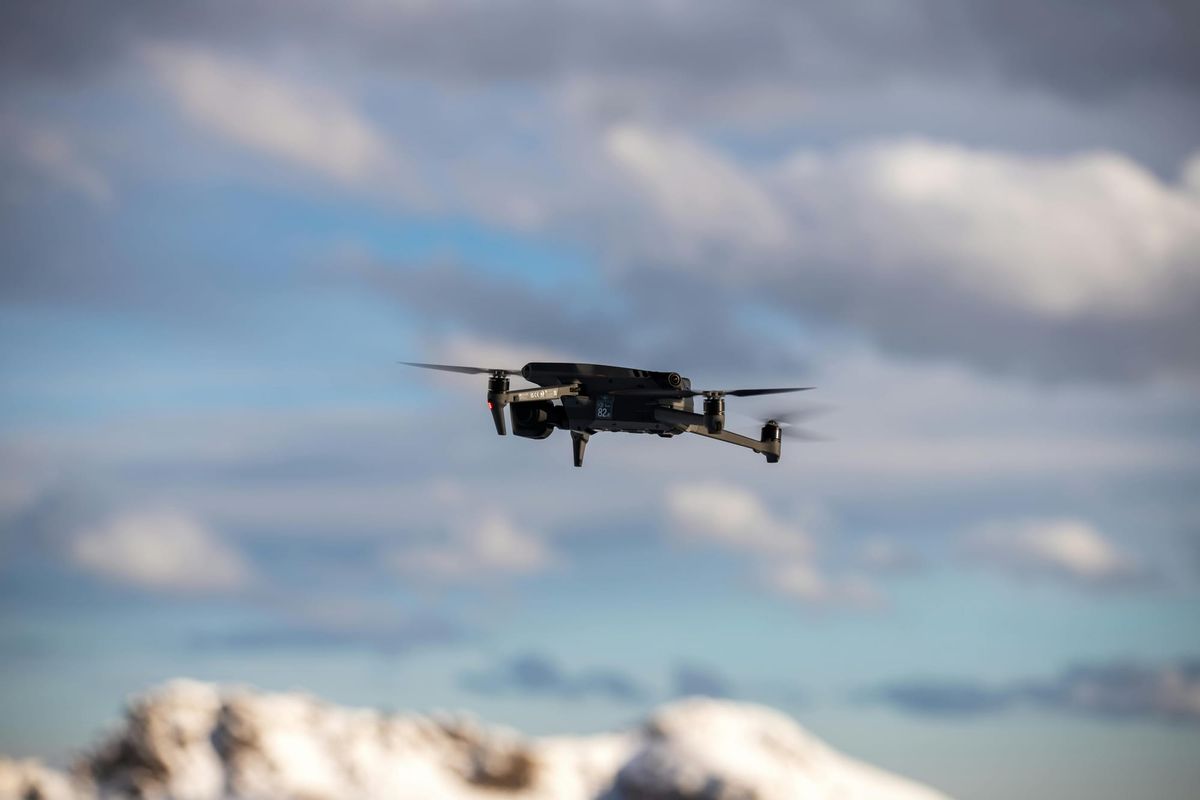
The RFI describes a paired architecture built around two interdependent components. The first is the drone itself: small unmanned aerial systems in the Group 1-3 range, covering platforms from roughly under five pounds to 1,320 pounds, capable of autonomous formation flight, mission execution, collision avoidance, and navigation in environments where GPS signals are jammed or denied. The second is the container: a standardized logistics box — compatible with Conex-type containers, ISU containers, or 463L pallets used across military transport systems — that functions not merely as storage but as a self-contained robotic mission hub. This container would manage storage, internal logistics, launch sequencing, recovery, recharging or refueling, and mission-control functions entirely on its own.
The constellation populations described in the RFI may comprise up to 500 platforms, with the exact number varying depending on payload type. Each drone would carry a subsystem or independent payload configured for a specific mission role — reconnaissance, strike, electronic warfare, communications relay, targeting — and the full constellation would maintain high operational availability across multi-day periods without requiring resupply or human technicians.
The autonomy standard DARPA is seeking is formally described as Autonomy Level 4. At this level, human operators are responsible only for defining the mission's objectives. Everything else — launch sequencing, path optimization, formation management, collision deconfliction, mission replanning, constellation reshaping, post-flight inspection, recharge cycles, and relaunch — is handled by the system itself, without continuous human oversight or intervention. The drones and the container, together, would constitute a combat system capable of sustaining operations independently.
The Container as a Weapon System
The container component of this architecture deserves particular attention, because it represents a fundamental rethinking of what military logistics means.
Conventional drone operations require substantial infrastructure: airfields, ground control stations, maintenance crews, communications links, fuel or battery logistics chains, and the human operators who fly each platform. All of that infrastructure is visible, targetable, and manpower-intensive. An adversary planning a first strike knows exactly where to look. It is the same calculus that makes large fixed military air bases, with their visible runways and fuel depots and aircraft hangars, priority targets in any major conflict.
A containerized autonomous drone hub eliminates most of that signature. A standard shipping container sitting in a port, on a railroad flatcar, on the deck of a merchant vessel, or in the bed of a truck does not look like a military asset. It does not need to. According to DARPA's specifications, the container must be capable of operating without GPS — meaning it cannot be tracked by satellite navigation jamming — and must not generate an anomalous thermal signature before launch. The system, by design, is intended to be indistinguishable from the commercial logistics environment that surrounds it until the moment it activates.
From a tactical standpoint, this transforms the entire concept of base defense and force dispersal. A single commander could position containerized drone constellations across dozens of dispersed logistics nodes — a warehouse, a port berth, a forward operating base, an allied commercial facility — and activate them sequentially or simultaneously according to mission need. The force becomes distributed by default, hardened against preemptive strike not by armor or fortification but by invisibility and proliferation.
DARPA's specifications require the container to handle not just launch but full recovery and turnaround: drones must land back inside, be inspected, recharged or refueled, have damaged platforms swapped out, and be relaunched — all automatically. This is technically demanding work. Battery-only drones face discharge depth and recharge-cycle constraints. Hybrid-electric aircraft add mechanical complexity. Fixed-wing platforms are efficient in flight but notoriously difficult to recover in compact areas without human assistance. The container must solve all of these engineering problems simultaneously, at the scale of hundreds of platforms, without a technician in sight.
Operation Spiderweb: The Proof of Concept DARPA Is Building On
DARPA's RFI does not exist in a vacuum. It was inspired, at least in part, by events that have already demonstrated the operational potential — and the transformative danger — of containerized drone warfare on a real battlefield.
On June 1, 2025, Ukraine's Security Service launched Operation Spiderweb. The operation was years in the planning, kept secret even from Ukraine's closest allies, and executed with a simplicity that made its audacity all the more striking. Ukrainian operatives smuggled 117 first-person-view (FPV) drones into Russia — concealed inside ordinary wooden containers mounted on flatbed trucks — and drove them to positions near five major Russian air bases spanning 4,000 kilometers from Murmansk in the Arctic to Irkutsk in Siberia. At the designated moment, the trucks' roofs opened remotely, and the drones launched.
The results were catastrophic for Russia. More than 40 aircraft were hit — Tu-95 strategic bombers, Tu-22M3 medium bombers, and A-50 airborne warning and control aircraft, assets central to Russia's long-range strike and surveillance capabilities. Ukrainian officials estimated the damage at approximately $7 billion. Russian military bloggers called it their "Pearl Harbor." The U.S. Army's Unmanned Advanced Lethality Course director described Spiderweb as "the one event that I teach to the students" — the single operation most worth studying in the emerging canon of drone warfare.
What made Spiderweb instructive was not just the destruction. It was the method. Cheap drones, under $2,000 each, launched from indistinguishable civilian containers, destroyed irreplaceable aircraft worth hundreds of millions of dollars apiece. The cost exchange was grotesque in Ukraine's favor. Russian air defenses, designed to detect aircraft and missiles approaching from known vectors, had no framework for intercepting a threat that arrived from inside a parked truck.
DARPA is explicitly building on that lesson. The containerized autonomous constellation concept is, in strategic terms, Operation Spiderweb formalized, industrialized, scaled to 500 platforms, and made self-sustaining — operated not by Ukrainian intelligence officers who spent 18 months planning a one-time covert insertion, but by a military logistics chain that can position containers anywhere its supply network reaches.
The Autonomy Challenge: What Level 4 Actually Requires
The demand for Autonomy Level 4 operation is not simply an engineering specification — it is a fundamental statement about how DARPA envisions human beings fitting into the future of aerial combat, and it poses some of the most demanding technical problems in the field.
At Autonomy Level 4, the system is expected to handle autonomous mission replanning in real time when conditions change — when a target moves, a threat emerges, a drone is lost, communications degrade, or weather shifts. It must manage dynamic task allocation across hundreds of platforms, continuously reassigning roles within the constellation as the situation evolves. Formation reshaping and collision deconfliction become critical when 500 aircraft are operating in close proximity, drawing on edge-based computing — processing happening onboard each platform rather than relying on a distant ground station — to make decisions faster than any human operator could.
In GPS-denied environments, which DARPA explicitly specifies as a required operational condition, the navigation challenge intensifies. Modern adversaries — China and Russia first among them — have invested heavily in GPS jamming and spoofing capabilities. A drone constellation that depends on satellite navigation would be paralyzed in the first hours of a major conflict. DARPA's requirement that the system operate in GPS-denied environments demands alternative navigation approaches: inertial navigation systems, terrain-relative navigation, visual odometry, or multi-modal sensor fusion.
Communications in a contested electromagnetic environment add another layer of complexity. The RFI calls for low-probability-of-intercept and low-probability-of-detection communications — meaning the data links between drones, and between the constellation and its human commanders, must be designed to be invisible to enemy electronic surveillance. Spectrum-agile data links that automatically shift frequencies to avoid jamming are part of this requirement, as is onboard decision logic capable of preserving mission continuity during periods of complete communications blackout.
The technical requirement is perhaps best summarized this way: DARPA wants a system that can be pointed at a problem by a human commander and then left alone to solve it, in a hostile electromagnetic environment, for days, without any additional human input, while maintaining the situational awareness and coordination discipline of a well-drilled aircrew. No such system fully exists today. The RFI is an invitation to the defense industry to propose how to build one.
Strategic Context: The Indo-Pacific and the Distributed Force Problem
The strategic rationale for DARPA's program extends well beyond the lessons of Ukraine and the Middle East. It speaks directly to the central military challenge the United States faces in the theater it considers most consequential: the Indo-Pacific.
A conflict over Taiwan, or more broadly across the first island chain, would present the U.S. military with a problem unlike any it has faced in the post-Cold War era. China's anti-access and area-denial networks — the DF-series ballistic and cruise missiles, the anti-ship missile batteries, the growing submarine fleet — are specifically designed to hold large, fixed American military bases at risk from the opening moments of any conflict. Andersen Air Force Base on Guam, Kadena on Okinawa, Clark and other facilities in the Philippines: all are well within range of Chinese strike systems, and Chinese military doctrine emphasizes destroying them early to degrade U.S. sortie generation before American airpower can be brought to bear.
The containerized drone constellation is, in part, an answer to this problem. A force that can be distributed across hundreds of dispersed positions — logistics hubs, allied commercial facilities, maritime corridors, small island outposts — and that requires no visible airfield infrastructure to operate cannot be neutralized by a finite number of precision strikes on known locations. The container becomes the airfield. And unlike a concrete runway, it can be moved.
Defense analysts have argued that dispersing containerized drone systems across the first island chain could give U.S. commanders persistent ISR coverage, communications relay, electronic attack capability, and precision strike options across an enormous operational area, without concentrating personnel and high-value aircraft at the locations an adversary's targeting system is already tracking. The same containers could serve dual functions: appearing to be commercial logistics infrastructure while constituting a concealed military network, activated on command.
China is watching this development closely, and is not idle. The People's Liberation Army has been investing heavily in AI-enabled swarm technology, explicitly described by U.S. intelligence assessments as intended to overwhelm advanced air defenses in Taiwan and U.S. military infrastructure in the Indo-Pacific during a conflict. The race to develop autonomous drone swarm capabilities is, in effect, already underway on both sides of the Pacific.
Technical Limitations and Open Questions
DARPA's RFI is deliberately open-ended on many of its technical specifications — a recognition that the agency does not yet know exactly what solutions are possible, and an invitation to industry to help define them. But that openness also reflects genuine uncertainty about whether all of the requirements can be simultaneously satisfied.
A 500-drone constellation is useful only if those aircraft can survive jamming, navigate without GPS, avoid collisions with each other in degraded communications conditions, deliver actionable data to commanders who may themselves be operating with limited connectivity, and be replaced at a rate the defense industrial base can actually sustain. The tension between autonomy, payload capacity, communications security, electromagnetic resilience, cost per unit, and maintainability may pull any given design in incompatible directions.
The container itself faces engineering tradeoffs that have no obvious solution. Launch cells for large numbers of small drones must be compact, but recovery of those drones at speed without damaging them requires space and precision. Recharging or refueling 500 platforms quickly requires substantial onboard power generation — power generation that itself has weight, volume, and heat signature implications. And the requirement for the container to operate without GPS while also managing its own internal logistics and drone health monitoring adds computational and sensor demands that must fit inside a standardized box.
There are also deeper questions about the human-machine relationship that Autonomy Level 4 implies. A constellation authorized to conduct strike missions, making its own targeting decisions in a GPS-denied environment with no routine human oversight, raises legal and ethical questions that the RFI does not address — and that the U.S. military's existing frameworks for autonomous weapons have not fully resolved. The question of who is accountable when a 500-drone autonomous constellation makes a targeting error in a congested operational environment is not answered by the technical specifications alone.
The Industrialization of Spiderweb
What Ukraine demonstrated with 117 hand-smuggled drones launched from improvised wooden containers in a one-time intelligence operation, DARPA is now attempting to institutionalize as a repeatable, scalable, military-standard capability. The conceptual leap is enormous: from a bespoke covert operation requiring 18 months of preparation to a system that any forward-deployed commander can position and activate on operational demand.
If the program succeeds — if industry can answer the technical requirements DARPA has laid out — the implications extend in every direction. The U.S. military would gain the ability to project persistent air presence across any theater where shipping containers can be moved, without building a single runway. Adversaries would face a targeting problem with no clean solution: how do you preemptively neutralize a military capability that is indistinguishable from commercial logistics infrastructure until the moment it attacks? And allies and partners would gain access to a force-multiplication tool that does not require the basing agreements, runway construction, and political negotiations that conventional airpower demands.
The same technology, of course, will not remain exclusively American. The democratization of drone warfare that Spiderweb illustrated — cheap platforms, commercial containers, devastating results — is a dynamic that cuts in both directions. A containerized autonomous drone swarm built to American military specifications is a system that a near-peer adversary will study, replicate, and deploy. The strategic advantage of being first to field it is real, but it is not permanent.
For now, DARPA has asked the defense industry a question: can you build the box that launches a war? The responses submitted before the May 15 deadline will help answer it. The answers will shape the character of warfare for decades.
Key Facts at a Glance
- Program notice: DARPA-SN-26-33 (RFI, not a contract award)
- Issuing office: DARPA Tactical Technology Office
- Published: April 14, 2026; updated May 8, 2026
- Industry response deadline: May 15, 2026
- Platform class: Group 1-3 unmanned aerial systems
- Constellation size: Up to 500 platforms per container
- Autonomy level required: Level 4 (human defines mission; system handles all execution)
- Required operating conditions: GPS-denied environments; contested electromagnetic spectrum
- Container compatibility: Conex-type, ISU, 463L pallet-compatible containers
- Mission types specified: Reconnaissance/ISR, electronic warfare, communications relay, targeting, strike
- Operational endurance: Multi-day continuous operations without human resupply or intervention
- Primary operational precedent cited: Ukraine's Operation Spiderweb (June 1, 2025)
- Key strategic theater: Indo-Pacific (anti-access/area-denial environment)
ArmedForcesNews.com covers U.S. and global military developments. All figures cited are sourced from official U.S. government releases, DARPA contracting notices, and open-source defense reporting.